
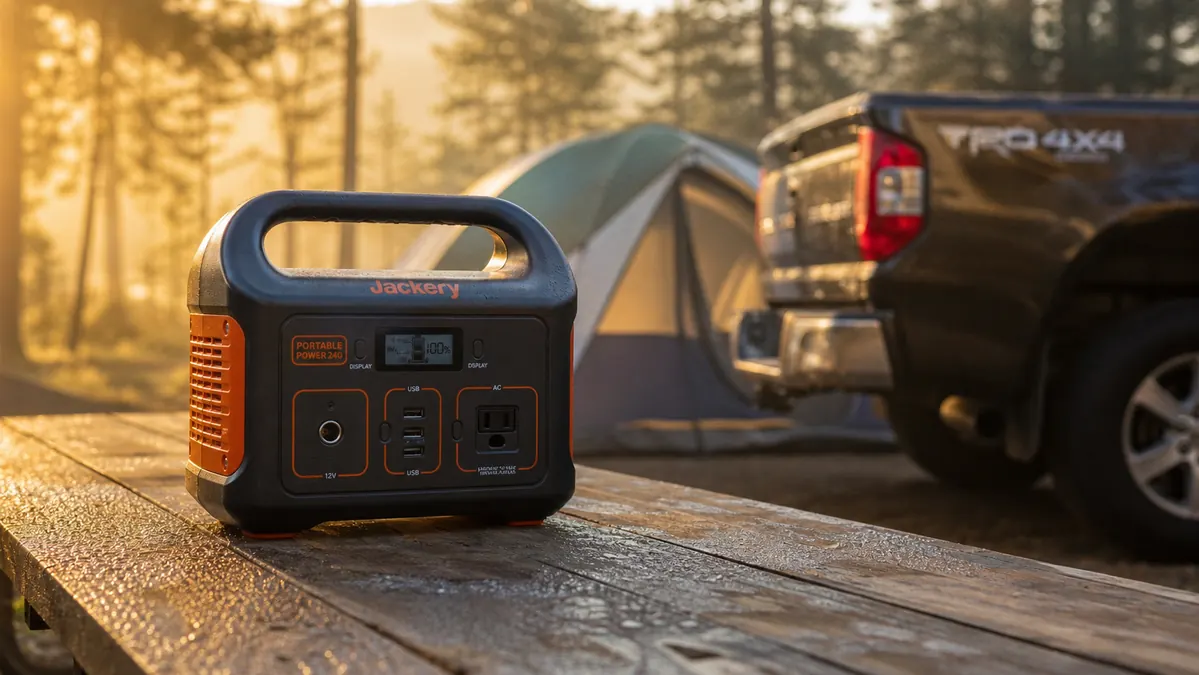
I bought my power station the same week I finally got tired of running my truck for twenty minutes just to top off a phone. If you car camp on weekends the way I do, you already know that math doesn't work. You either run the engine, burn through a pack of AAs a trip, or you find something that holds a real charge and doesn't need babysitting. That's the job I gave the Anker 521 last spring, and I've had it in the truck bin ever since.
This isn't a first-impressions review. I've taken this unit on somewhere around twenty nights out since April, from a three-day trip at a state park with hookups I never used to a stretch of dispersed camping where it was the only power source for four of us. What follows is what actually happened, good and not so good.
The Quick Verdict
A dependable mid-size power station that covers phones, lights, and a small cooler for a weekend without complaint, as long as you don't expect it to run a full-size fridge or recharge itself overnight off a small panel.
Amazon Check Today's Price →Tired of your phone dying by day two at camp?
The Anker 521 is the box that ended that problem for me. Check today's price and see if it fits your setup.
Amazon Check Today's Price on Amazon →How I've Used It
My test wasn't a lab bench, it was a truck bed. The power station rides in a milk crate strapped behind the cab, and it comes out every trip whether we're at a developed campground or somewhere with zero services. I charge it to full the night before I leave, using the wall adapter, and I don't touch a generator or the truck's alternator the entire trip unless something goes sideways.
The loads I put on it are ordinary weekend-camper loads. Two phones charging overnight, a headlamp and a lantern topped off daily, a Bluetooth speaker for a couple hours in the evening, and on the longer trips, a 12V cooler running intermittently to hold food cold. That last one is the real test of a 256Wh battery, because coolers cycle their compressor on and off all day and it adds up.
I also ran it once off a small folding solar panel for two days at a spot with no outlet within forty miles, just to see what recovery looked like without a wall plug. More on that below, because it's the part that surprised me the most.
Weather has been part of the test whether I planned it or not. It's sat through a couple of afternoon downpours under a tarp, ridden along on dusty forest roads, and spent one night at close to freezing at higher elevation. None of that is abuse, it's just normal weekend camping, and it's the kind of use that tells you more about a piece of gear than a spec sheet ever will.
What's Actually Inside the Anker 521
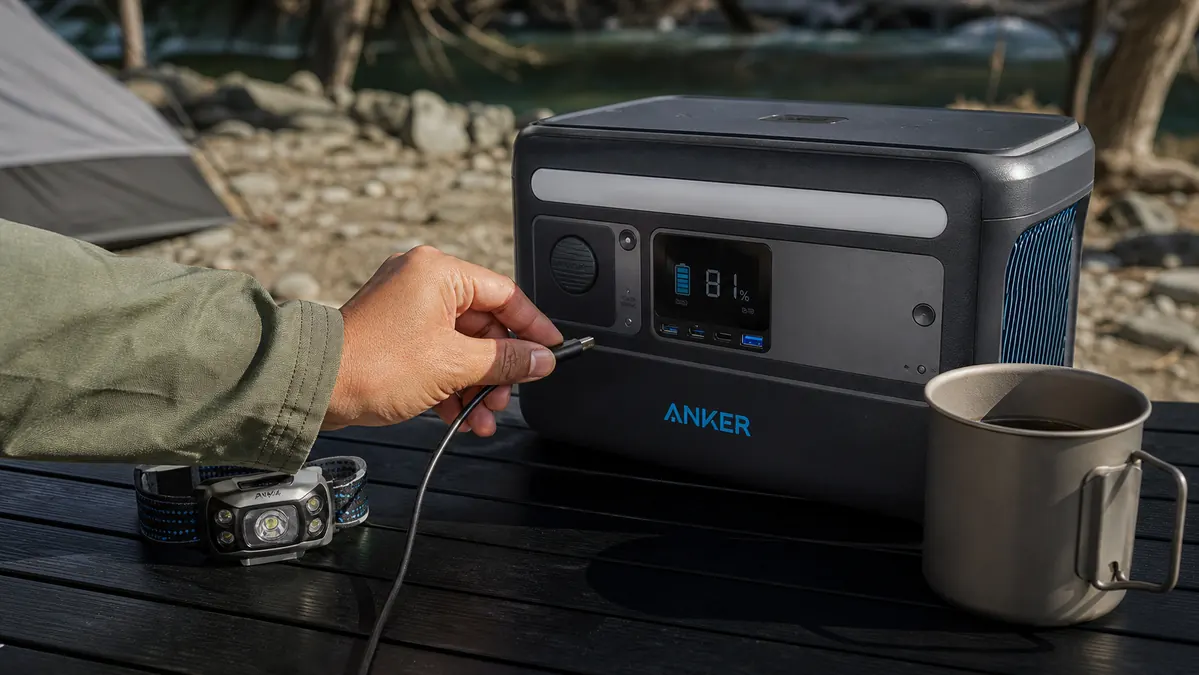
The Anker 521 uses a LiFePO4 (lithium iron phosphate) cell instead of the standard lithium-ion pack most budget power stations shipped with a few years back. That matters more than it sounds like on paper. Anker rates this chemistry for around 3,000 charge cycles before it drops to 80 percent capacity, which is roughly four to five times what a typical lithium-ion power bank of similar size will give you. After a full season of weekly-ish use, mine still holds what feels like a full charge on the app's percentage readout, and I haven't noticed the kind of falloff I've seen in cheaper units by this point.
At 256 watt-hours, this sits in the middle of the portable power station lineup, bigger than the phone-and-headlamp units but well below the whole-house backup boxes. It has six ports total: two AC outlets, two USB-A, and two USB-C, one of which pushes 100W for laptop charging. The AC inverter is rated at 200W continuous with a 400W surge, which is enough for small electronics and the cooler I run, but it will not run a microwave, a coffee maker, or anything with a heating element. I learned that one the hard way trying to run a travel kettle at 6am and getting an overload shutoff instead of coffee.
The whole unit weighs about 7.5 pounds, small enough that it doesn't feel like a chore to carry from the truck to the picnic table, which matters more than people expect when you're the one hauling gear at 9pm with a headlamp on.
Build Quality After Months in a Truck Bed
The plastic housing has held up better than I expected given how it actually travels, tossed in a milk crate next to a cooler and a folding table, sliding around on gravel roads more than once. There's no cracking around the port covers, and the little rubber flap over the AC outlets still seats properly instead of flopping open the way cheap ones start to after a season. The carry handle is solid plastic and hasn't loosened at all, which is the part I expected to fail first on a unit this size.
The one physical complaint I have is the outer shell gets slick when it's wet or your hands are damp from setting up in the rain. There's no rubberized grip texture anywhere on the case, just smooth plastic, and I've nearly set it down harder than I meant to a couple of times carrying it from the truck in a drizzle. It's never actually slipped out of my hands, but I notice it every time conditions turn wet.
The front display has stayed easy to read even in direct sun, which isn't true of every power station I've used. It shows remaining percentage, input and output wattage, and estimated time remaining at the current draw, and all three of those numbers have matched what I actually experienced closely enough that I trust the readout now instead of double-checking it against my phone's stopwatch.
Runtime, In Real Numbers
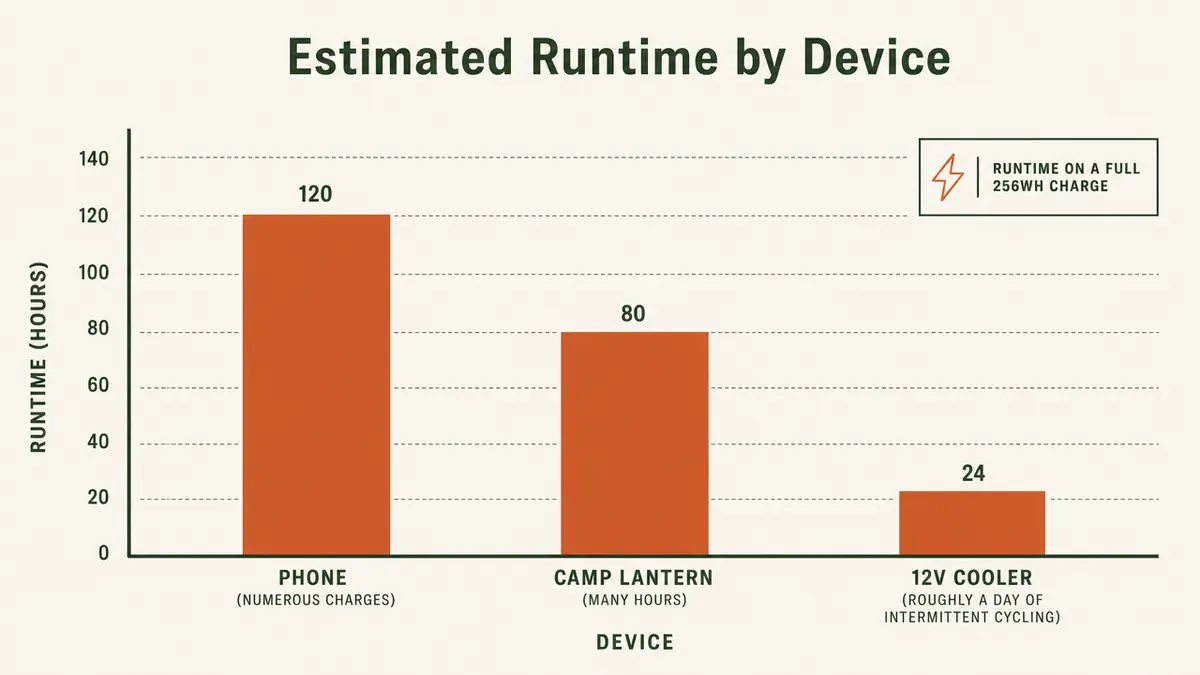
Here's what a full 256Wh charge has actually gotten me across a season of use, not the marketing math. A phone charge runs somewhere around 15-18Wh depending on the phone and how depleted it started, so a full battery covers roughly 12-15 phone charges if that's the only thing you're drawing on it. A camp lantern pulling 3-5 watts will run for well over 40 hours straight on a full charge, which in practice means it never actually dies on a weekend trip because I'm not leaving it on all night.
The cooler is the one that actually stresses the battery. A small 12V cooler cycling on and off through the day, the way coolers do rather than running continuously, pulled the Anker 521 down from full to around 15-20 percent over roughly 20-24 hours in warm weather. That's a full day of keeping food cold, not two. On a three-night trip, I've had to top the battery back up by day two if the cooler is running the whole time, either off a wall outlet at a campground with hookups or off my truck's 12V socket on the drive between spots.
If you're weighing this against a different capacity or brand, our side-by-side comparison against the Jackery Explorer 300 breaks down where the extra watt-hours actually help and where they don't.
Solar Recharging: The Part That Surprised Me
I tested solar recharging with a 60W folding panel over two clear days at a dispersed site, mostly out of curiosity rather than necessity. It worked, but slower than I expected. A 60W panel in decent midday sun brought the battery up maybe 30-40 percent over a full day of sitting in direct light, angled and repositioned a few times. That's usable if you're stationary and patient, but it is not a fast recharge, and cloud cover or shade cuts it further. If solar is your main charging plan rather than a backup, budget for a bigger panel than the compact ones sold as accessories, or plan on topping off from the truck between trips instead.
Charging Habits I've Settled Into
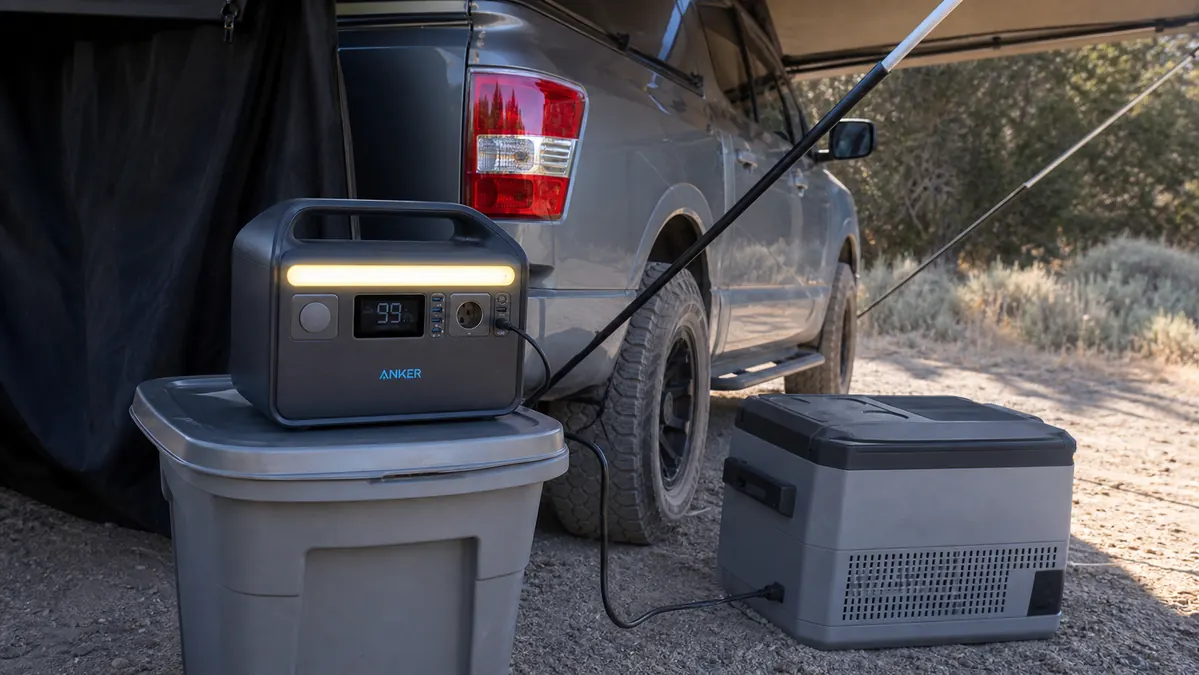
After a season of use, I've landed on a simple routine. Full charge from the wall the night before every trip, no exceptions, since that's the fastest and most reliable way to start at 100 percent. On the drive to the campsite, if the trip is longer than two nights, I'll plug it into the truck's 12V outlet for the last hour just to squeeze a little back in before we set up camp.
I've stopped trying to be clever about topping it off mid-trip unless there's an actual outlet nearby. Chasing a partial solar charge or running it off the truck while parked at camp burns more of my attention than it's worth for the percentage it recovers. It's easier to just plan around the roughly two-and-a-half day window it gives me on a normal load and pack accordingly.
Who This Is For
This power station fits the weekend car camper who wants lights, phones, and maybe a cooler covered without running a generator or draining the truck battery. If your camping looks like mine, drive in, set up a base camp, stay two or three nights, this size and this price point line up well with what you actually need powered.
It's also a solid fit if you camp with a small group and want one shared charging hub instead of everyone fighting over the truck's single 12V outlet. Six ports is enough that two or three people can all keep their devices topped off without anyone waiting their turn.

Who Should Skip It
If you're trying to run a full-size fridge for a week off grid, or you need to power tools, a CPAP plus a fridge plus lighting simultaneously, 256Wh will not stretch that far and you'll be recharging daily no matter what you do. Look at a bigger capacity unit instead, something in the 500Wh-plus range built for that kind of load.
Solo backpackers hauling everything on foot should also look elsewhere. At 7.5 pounds this is built for a truck bed or trunk, not a pack, and a small power bank in the two-to-four-ounce range will cover a phone and headlamp for a fraction of the weight.
What I Liked
- LiFePO4 battery holds up well after a full season, no noticeable capacity loss
- Light enough at 7.5 lbs to carry without a second trip
- Six ports cover phones, lantern, speaker, and cooler at the same time
- Recharges fully overnight off a wall outlet before a trip
- Display readout has stayed accurate and readable in direct sun
Where It Falls Short
- 200W inverter can't run anything with a heating element
- Cooler use alone drains it in about a day of intermittent cycling
- Solar recharging is slow unless you use a larger panel than the compact kits
- No built-in handle grip texture, gets slick with wet hands in rain
It's not the box that runs everything. It's the box that quietly keeps the ordinary stuff running so you stop thinking about it.
Tradeoffs I've Made Peace With
I considered a bigger unit before I bought this one, something closer to 500Wh, mostly because I worried I'd be recharging constantly. In practice, for the two-to-three-night trips that make up most of my camping calendar, 256Wh has been the right size. The bigger units weigh noticeably more and cost more, and I wasn't running a fridge that needed that headroom. If your trips run longer or your loads are heavier, that math shifts, and it's worth reading our honest rundown of where this unit falls short before you commit to this size.
The other tradeoff is charge speed from the wall. A full recharge from empty takes a bit over an hour with the included adapter, which is fine at home the night before a trip, but it means you can't top it off quickly at a campground outlet during a short break. I plan around that now instead of fighting it.
I've also made peace with the fact that this isn't a set-it-and-forget-it appliance. I still glance at the display once or twice a day at camp to see where the charge sits, mostly out of habit at this point rather than genuine worry, but it's a small extra task compared to just plugging into shore power at an RV site.
A season of weekend trips later, this is still the box in my truck bed.
If your camping looks like mine, phones, lights, maybe a cooler, the Anker 521 is worth checking at today's price.
Amazon Check Today's Price on Amazon →